
Landmarks of Ivano-Frankivsk
The city of Ivano-Frankivsk is a major industrial and cultural centre of Prykarpattia. It is situated between two rivers — the Bystrytsia Nadvirnianska and the Bystrytsia Solotvynska. The history of Ivano-Frankivsk is rich in events that have shaped the city’s unique modern appearance.
Various festivals — both international and nationwide — are held in Ivano-Frankivsk, many of which have already become traditional.
A wide network of cultural institutions offers residents and guests of Ivano-Frankivsk new opportunities to join the inexhaustible sources of spirituality, culture and art.
The city’s cultural institutions are diverse: museums and galleries, libraries, schools of aesthetic education, cinemas, night clubs, a municipal leisure centre, a centre of contemporary art, the regional philharmonic, a folklore theatre, a musical-drama theatre, a puppet theatre, and sports and entertainment complexes. Guests of the city, visiting these cultural institutions, have a wonderful opportunity to feel a piece of the soul of the people of Ivano-Frankivsk.
Book a tour of the enchanting, historic city of Ivano-Frankivsk
+38 050 434 09 58Ratusha (Ivano-Frankivsk Local History Museum)
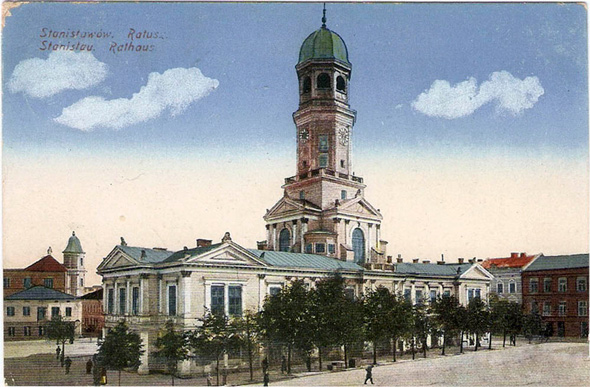
This is the oldest building in Ivano-Frankivsk. Four periods can be distinguished in its history:
• 1.1 The First Ratusha (1672–1677). The town hall was used for meetings of the local council and court. From its tower they monitored outbreaks of fire and also observed the movements of Turkish and Tatar detachments during the Turkish-Polish war. In 1677 the town hall was dismantled because of its low reliability; according to other sources — because of the dissatisfaction of the city’s founder, Andrzej Potocki, with its architecture.
• 1.2 The Second Ratusha (1695–1868). In 1695, on the order of the city’s owner Józef Potocki, a new town hall was built. It had nine storeys and a cross-shaped plan. The town hall had a clock that struck the time every fifteen minutes with the help of bells. Above the clock there was a room for guards who, upon detecting danger (fire or enemy attack), blew trumpets. On the ground floor there were shops — as many as 24. In the basement of the town hall there was a prison where criminals and opryshky were kept.
• 1.3 The Third Ratusha (1871–1915). In 1868 the Marmulyadova Fire broke out in the city. A quarter of the city burned down, and only the iron skeleton of the town hall remained. In 1871 a new town hall was built in the form of a two-storey building with a high tower. Up to the fifth floor it was faced with white marble, and the city council meeting hall was decorated with inscriptions about historical events of Ivano-Frankivsk.
• 1.4 The Fourth Ratusha (1935 – present). During the First World War the town hall was severely damaged by Austrian artillery. The building was in an emergency condition. Because of the economic crisis of the 1920s the city authorities were unable to carry out reconstruction. Construction work began only in 1929 and lasted until 1935. During the Nazi occupation the Germans decided to destroy the town hall, but managed only to blow up the north-western wing. In 1959 the Ivano-Frankivsk Local History Museum was opened in the premises of the Ratusha.
The museum’s collections number more than 110 thousand items, including icons, weapons, paintings, graphics and archaeological artefacts.
Address: 76018 Ivano-Frankivsk,
4a Halytska Street
Residents and guests of Ivano-Frankivsk have the opportunity to enjoy a view of the city from above. The observation deck is located on the tower under the dome at a height of 33.3 metres. To climb the tower you will need to overcome 166 steps. So stock up on energy and stamina. But the result is worth it!
Halytska Brama (Galician Gate)
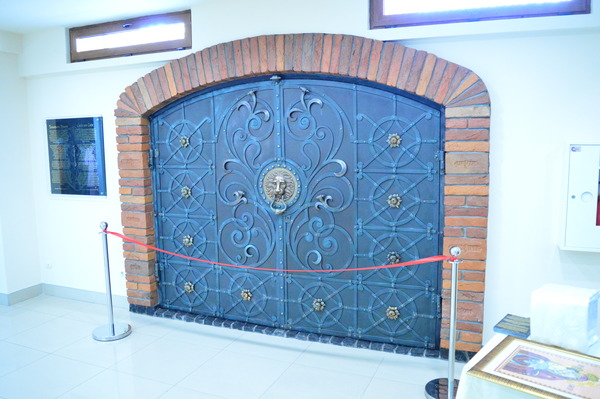
In the 17th century one could enter Stanislaviv through two gates — the Tysmenytska and the Halytska. Legends circulated about the city’s secret underground passages. The city of Stanisław Potocki was famous for these mystical undergrounds, which served not only as a hiding place but also as a means of quick escape in case of an enemy attack. It was here, near the Ratusha, that a large underground corridor was found through which a horseman could pass. The entrance was paved with stone.
The gate was recreated by the well-known Prykarpattia artist and blacksmith Serhiy Polubotko. The name of the gate was not changed — Halytska; the original stood 50 metres from the “Galeria-N” shopping centre. Its foundations were discovered in the early 2000s. The renewed gate is the successor of the ancient fortress structure. An authentic appearance is given to this forged masterpiece by the portal built of old Stanislaviv brick from the end of the 19th century.
In the middle of the gate, as in ancient times, there is a relief lion’s head. The golden lion was the state coat of arms of the Halych princes; its image adorned the battle banners and shields of the military retinue. The people of Halych believed that the lion symbolises courage and nobility, prosperity and happiness.
Legends are already circulating about the magical properties of the golden lion on the gate. There are many small shops in the city centre. One day a saleswoman from one of them jokingly rubbed the lion’s nose in the morning and made a wish. That day turned out to be very successful for her both at work and in her personal life. The next time the incredible story repeated itself! Her joy knew no bounds. Now the only question is — what is the radius of action of the lion from the Halytska Brama? Local residents believe that if you rub this lion and make a wish, it will definitely come true.
Rynok Square, 1 (TC “Galeria “N”)
The Largest Stained-Glass Hutsul Plate-Panel
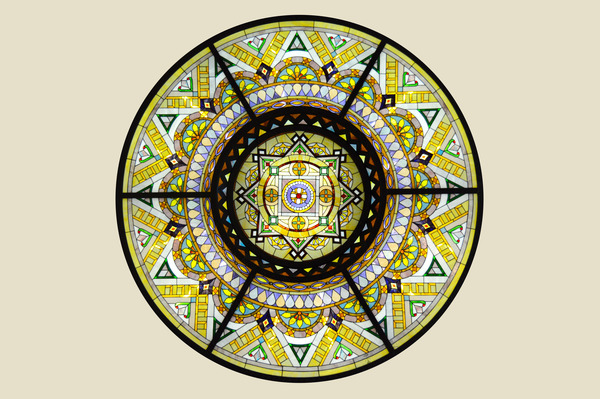
The largest stained-glass Hutsul plate-panel in Ukraine. Submitted to the Guinness Book of Records. 2,500 elements are compositionally combined in an ancient Hutsul ornament. Ancient signs of the Sun, Earth, Universe and Kin symbolise harmony and unity, the perfection of Nature and the continuity of being. The sacred geometric ornament is an amulet and a code of our people.
Address: 40 Nezalezhnosti Street
Restaurant “Nadiya” (National Hall)
Parish Church and Bell Tower (Art Museum) 1672–1703
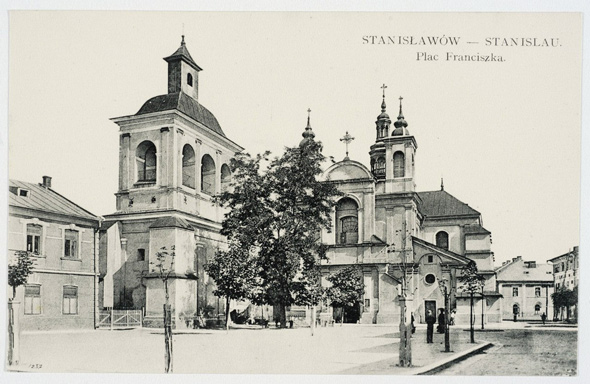
This is one of the oldest architectural monuments of Ivano-Frankivsk.
Construction of the church began in 1672. The project was developed by the French architects François Corassini and Karol Benoe. Construction of the church was completed in 1703.
In 1892 the church was repaired and restored. A music school began operating at the church; in 1900 an organ was installed above the main entrance, which was lost in the post-war period.
In 1962 the Soviet authorities closed the church. In 1965 the building was transferred to the geological museum of the Institute of Oil and Gas.
In 1980, after repairs, the Art Museum was opened in the premises of the church.
The museum’s collections number more than twelve thousand works, including monuments of icon painting and Baroque sculpture, works by Polish, German, Austrian and Italian masters of the 18th–20th centuries, and works by Ukrainian artists of the second half of the 20th century.
Address:
8 Sheptytskyi Square
Cathedral of the Holy Resurrection
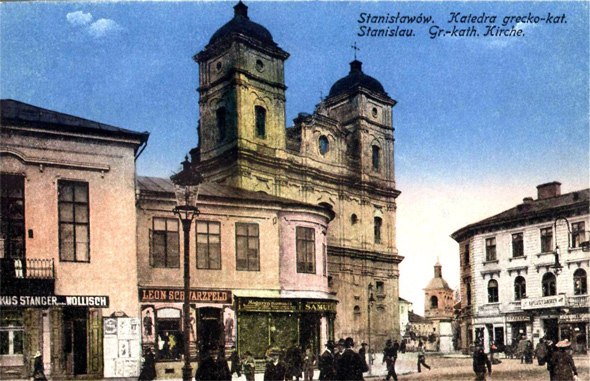
Built in the style of the Austro-Bavarian Baroque school in 1729. At the end of the 19th century the well-known Ukrainian artists A.I. Manastyrskyi and M.D. Sosenko executed the wall paintings in the building.
Today it is the main (cathedral) church of the Ivano-Frankivsk Eparchy of the Ukrainian Greek Catholic Church.
Address:
22 Sheptytskyi Square
Market Square (Rynok Square)
The central square of Ivano-Frankivsk. The square has a shape approaching a rectangle. In ancient times squares were built rectangular or square, from which streets radiated.
House numbering began from one of the corners of the square. Number one was always the Ratusha.
Today Rynok Square is one of the cultural centres of Ivano-Frankivsk. Many concerts, festivals, exhibitions and competitions take place here.
“Stometrívka”
This is the pedestrian part of Nezalezhnosti Street. A favourite place of rest for city residents. On the “stometrívka” there are bookshops, restaurants, pizzerias and shops. Street musicians and artists perform quite often.
The name “stometrívka” is rather conventional, because the real length of the “hundred” is 450 metres.
Address:
Nezalezhnosti Street
Taras Shevchenko Park of Culture and Recreation
In ancient times an oak grove, a remnant of the Black Forest, was located on the site of the park. The owners of the city, the Potockis, often organised hunts for wild animals there.
In the 19th century these lands were turned into fields and pastures.
In 1895 the city authorities decided to create a park. Trees were planted in the English landscape style.
In 1948 the area of the park increased by 28 hectares as a result of the annexation of the former private Romashkan park.
More than six thousand trees and over two thousand shrubs grow in the park. There are also exotic plants for Galicia: the French tulip tree, Japanese sakura, and Tibetan ginkgo.
Address:
126 Chornovola Street
Book a tour of the enchanting, historic city of Ivano-Frankivsk
+38 050 434 09 58